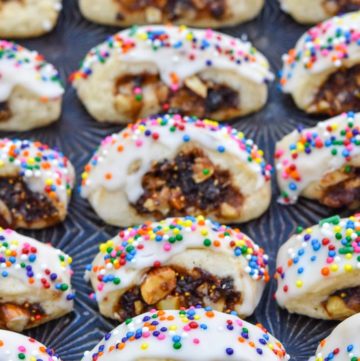
Italian Fig Cookies
These traditional Italian Fig Cookies (Cucidati) are filled with figs, raisins, honey, warm spices, and toasted nuts, all wrapped in a tender pastry and finished with sweet icing and festive sprinkles. A classic Sicilian Christmas cookie that's perfect for holiday baking, gifting, and cookie trays.
Servings 60 cookies
Calories 130kcal
Ingredients
FILLING:
- 1 cup soft dried Missions figs, stems removed
- 3/4 cup raisins
- 3/4 cup honey
- 1/4 cup brandy
- 1 1/2 teaspoons finely grated orange zest
- 1 teaspoon finely grated lemon zest
- 1 tablespoon ground cinnamon
- 1/4 teaspoon ground cloves
- 1/4 teaspoon ground nutmeg
- 3/4 cup whole almonds, toasted and coarsely chopped
- 3/4 cup walnuts, toasted and coarsely chopped
PASTRY:
- 4 cups all-purpose flour
- 1 cup plus 2 tablespoons granulated sugar
- 1 tablespoon baking powder
- 1 teaspoon salt
- 1 cup unsalted butter
- 2 large eggs, lightly beaten
- 1/2 cup whole milk
- 1 1/2 teaspoon vanilla extract
- 1 teaspoon finely grated orange zest
Icing:
- 1 cup confectioners' sugar
- 1/2 teaspoon vanilla extract
- 2-3 tablespoons milk
- 1/2 teaspoon fine orange zest
Instructions
Make Filling:
- In the bowl of a food processor, fitted with a metal blade, pulse together figs (1 cup) and raisins (3/4 cup) until finely chopped. Add the remaining filling ingredients and pulse just to combine. Transfer filling to a small bowl, cover with plastic wrap and refrigerate 8 hours to overnight.
Make Dough:
- In a large mixing bowl, whisk together flour (4 cups), baking powder (1 tablespoon), and salt (1 teaspoon). Cut the butter (1 cup) in with a pastry blender or 2 knives until the mixture resembles coarse meal, with some pea-sized lumps.
- Using a large fork, mix in eggs (2), milk (1/2 cup), vanilla (1 1/2 teaspoon), and orange zest (1 teaspoon) until soft dough forms.
- Divide the dough in half and form 2 balls. Place each ball of dough between two sheets of plastic wrap. Using your hands, flatten dough into a rough 6X4 inch rectangle. Chill until firm, at minimum 8 hours.
Make Cookies:
- Adjust the oven rack to the middle of the oven. Preheat oven to 350 degrees. Spray 2 baking sheet with nonstick cooking spray.
- On a well floured surface, roll one ball of dough (keep second ball in fridge) into a rough rectangle, about 15X14 inches. Trim into 13X10 inch rectangle. Save and chill trimmings. Cut trimmed rectangle into 4- 10X3X1/4 inch thick strips.
- Spread 1/3 cup of the filling lengthwise down the center of each strip, in a 1-inch wide log. Fold the sides over the filling then pinch the seam together to seal. Turn rolls over, seam side down, and gently press rolls down to flatten seams and form an elongated log, flat on the bottom and domed on top, like the shape of a biscotti.
- Using a floured knife, slice cut logs crosswise into slices just over 1 inch thick. Place cookies flat side down on prepared baking sheets 1/2 inch apart. Repeat with remaining dough and filling.
- Bake cookies one sheet at a time in the preheated oven until edges are golden, about 16-20 minutes. Allow cookies to cool 2-3 minutes on cookies sheets then transfer to a wire rack to cool until warm, about 5 minutes.
Icing:
- While the first batch of cookies bakes in the oven, make the glaze. Whisk together confectioners' sugar (1 cup), vanilla (1/2 teaspoon), 2 tablespoons milk, and orange zest (1/2 teaspoon) until smooth. Add more milk, slowly as needed to make glaze thick but pourable.
- Spoon glaze over warm cookies and sprinkle with nonpareils. Cool completely. Cookies can be stored, layered between sheets of waxed paper in an airtight container for 1 week or frozen for 1 month.
Notes
- Chill time = flavor time. Both the filling and the dough get better with an overnight rest. The dried fruit absorbs the brandy and honey, the spices bloom, and the dough relaxes so it rolls more easily and bakes up tender instead of tough.
- Don’t over-process the filling. You want a thick, slightly chunky mixture—almost like a rustic fruit paste—rather than a completely smooth purée. A bit of texture from the nuts and fruit keeps the filling interesting and helps it stay put inside the pastry.
- Think “firm but gentle” with the dough. Mix the dough just until it comes together, then stop. Overworking it can develop too much gluten, which leads to tough cookies. When you’re shaping the logs, be firm enough to seal the seams, but gentle enough not to smear the filling or stretch the dough too thin.
- Trim and reuse scraps. Don’t toss those trimmings! Gather up the dough scraps, press them into a rectangle, wrap, and chill. You can roll them out again to make a few extra cookies—perfect for “baker’s treats.”
- Ice while warm, sprinkle right away. The glaze grabs onto warm cookies and sets into a pretty, slightly opaque layer. Add the nonpareils immediately after glazing each batch so they stick before the icing crusts over.
Nutrition
Serving: 1cookie | Calories: 130kcal | Carbohydrates: 19g | Protein: 2g | Fat: 5g | Saturated Fat: 2g | Cholesterol: 15mg | Sodium: 44mg | Potassium: 89mg | Sugar: 10g | Vitamin A: 108IU | Calcium: 27mg